Right from the off, I’m going to be completely honest with you. I’ve used ChatGPT as a free therapist.
Don’t judge me; but sometimes, when you’re in the pits of over-analysing your thoughts, are experiencing symptoms of PTSD, or just needing a space to feel validated, ChatGPT can offer the safe space that you crave as a victim-survivor of sexual assault or abuse.
But is using ChatGPT as a therapist, or trauma dumping on ChatGPT as some like to call it, a good idea?
Are there any drawbacks?
In this post, I asked ChatGPT these very questions, to try and unearth whether or not using AI as free therapy is a hidden gem, or something that’s dangerous, and we should stay away from. Mixed in with my own experiences of using ChatGPT as therapeutic support, I hope that this post will help you to make up your own mind whether using AI tools is something you should include as part of your trauma coping strategies.
Why Do People Use ChatGPT as Therapy?
First, let’s start off with understanding why people might use ChatGPT for therapy in the first place. There are many reasons why you might turn to AI for support, especially if you are a trauma survivor. A simple Google search shows hundreds of discussions on Reddit that give examples of people using ChatGPT for various forms of therapy.
Among the reasons for using ChatGPT as therapy are:
- Being able to remain anonymous to the ‘person’ who you’re talking to (and yes, I say ‘person’ because ChatGPT isn’t a living human)
- Better availability and accessibility to survivors. Think about it; no waiting for an available appointment and no need to leave wherever you are to access support
- It can provide much-needed support between therapy sessions
- It’s free
- It gives you the opportunity to say things that you might not feel that you can say out loud
- There is no judgement from a person no-one to not believe you
- Wanting to test the waters with explaining what happened to you before telling a real person
- Wanting to ask if what you experienced was trauma before reporting what happened to you
ChatGPT can also feel like it’s ‘on your side’ and can validate your experiences. Here’s what it said to me when I was researching this post:
If you’re a survivor of sexual abuse (SA) or trauma and you’ve ever typed a question into this box looking for support, I want you to know: I see the courage in that. Seeking help—especially in the aftermath of trauma—can feel overwhelming, vulnerable, and sometimes even unsafe. Reaching out, even to an AI like me, is a sign of strength.
If that isn’t comforting and validating, then I don’t know what is. This response definitely sends the message that you’re in the right place and that ‘someone’ has your back.
5 Ways That ChatGPT Can Support Survivors of Sexual Assault and Abuse
Before we dive into the cons of using ChatGPT as therapy, I think it’s important to consider how AI can support survivors of sexual assault and abuse. Here are my top 5 ways in which I feel ChatGPT can support you in your journey of trauma recovery:
1. Helping You to Process What Has Happened
This could be by helping you to define certain words such as ‘coercion,’ ‘grooming,’ ‘minimisation,’ ‘trauma’…the list goes on.
Often, we hear words used that we don’t associate with our own experiences. For example, it was years before I even started to associate the phrase ‘sexual abuse’ with what happened to me.
Why?
Because to me it was ‘just one of those things’ that I hadn’t yet started to unpick and categorise in my mind for the trauma that it really was.
2. Giving You Grounding or Self-Care Strategies
ChatGPT is great at generating a list of self-care activities that you can run through and select what might be good for you in any given moment.
Equally, ChatGPT can write out guided meditations or grounding activities that could support you.
Such activities that it could generate include breathing exercises, affirmations, or calming routines.
3. Gaining Validation for Your Thoughts
As I keep mentioning, ChatGPT is not real, but it will likely (and has in my experience) respond in a way that validates however you are feeling and also your experiences.
That can be incredibly powerful.
Especially if you are unsure of who to talk to about the abuse you experienced, or feel that those who you’ve previously spoken to are getting fed up with listening to you. (Spoiler alert; if they’re proper friends, they won’t get fed up of listening to you).
4. Giving You Support With Your Writing
We can’t all be the next Virginia Woolf and poetically write how we feel.
And ChatGPT can help you to organise your thoughts and write out various pieces that can help you process what you’ve experienced. This could include poetry, a bog post, journal entry, a letter to the perpetrator, or any other form of writing you might want support with.
5. Just Being There
As I’ve said previously, sometimes, it’s 3am, you can’t sleep, and there’s no availability for online support services.
This is when you might just need to get thoughts out of your head and have someone validate you.
5 Reasons to Not Use ChatGPT As a Sexual Abuse Survivor
Ok, now we’ve looked at the reasons why you might want to use ChatGPT as a therapist, here is the other side of the argument and why ChatGPT might not be the best option to support you as you overcome your trauma.
1. It’s Not a Therapist
Probably the main reason not to use ChatGPT as therapy (and hopefully the most obvious!) is that it is not a real therapist.
It isn’t even a real person.
A real therapist who is a real person will have experience in building a rapport with you, gaining your trust, knowing when to say certain things, tailoring therapy to your individual needs, and utilising clinical judgement.
ChatGPT can’t do any of these things.
Whilst it can give generic advice, this won’t be tailored to you or your circumstances. Therapists, be it in counselling, psychology, or psychiatry, train for years to be qualified in what they do, and spend countless hours undertaking additional training and development activities to further refine their practice.
An AI-bot just can’t have that blend of theory and practical, hands-on experiences that they can tailor to you as an individual.
2. It Doesn’t Have the Backstory
Being an AI-bot, ChatGPT does not have the context or backstory of where you live or you as a person.
I’ll give you two examples here:
- When I started therapy, my therapist started by giving me a questionnaire to fill out. From this, she was able to tailor our therapy based on my responses. There’s nothing like this for ChatGPT. There’s no back story, no dive into what’s bought me to therapy, anything about me as a person, etc. Therefore, anything that ChatGPT tells me can only be personalised so much.
- ChatGPT has previously given me incorrect information about what I experienced because it didn’t understand which legal jurisdiction I live in. It gave me a lot of information about UK legislation, but living in Jersey, it didn’t always (unless I stipulated it) give me relevant information in relation to where I live. This can be tricky if you’re then asking ChatGPT legal information or about localised support services.
3. It Can Misinterpret What You’re Saying
ChatGPT can misinterpret what you’re saying. And it can also not generate answers if it thinks that you’re violating its usage policies.
Whilst talking to ChatGPT about abuse you’ve experienced might not exactly be violating ChatGPT’s usage policies, the use of certain words around sexual abuse might.
There are ways around this, such as using ‘SA’ in place of ‘sexual abuse.’ But you need to prompt ChatGPT so that it knows what you’re talking about and doesn’t interpret ‘SA’ in another way.
Receiving a reply that your conversation violated policies and ChatGPT could not return a reply to you can also be damaging.
Imagine pouring your heart and soul out only to be told you’ve violated a policy you didn’t know existed? Plus, you’ve bought up that trauma to write down and now you’ve been shut down with no-where to go.
This just wouldn’t, or shouldn’t, happen in therapy.
A therapist wouldn’t tell you to censor your story in any way and should support your narrative however you are able to tell it.
4. There’s No Emergency Support
If you say certain things to a therapist, they can signpost you to relevant services. They might also need to take matters into their own hands and refer certain information to safeguarding professionals.
ChatGPT can’t do either of these things.
Whilst it can pull up a list of services, there’s no guarantee as to the availability or relevance of what it recommends. Equally, it might recommend services that aren’t accessible in your location.
If you are experiencing a mental health crisis and at risk of harm, ChatGPT can’t do anything to help you. In these cases, you need a professional, not an AI bot.
5. There’s No Safety Netting
Because ChatGPT can’t see your face and read how you might be feeling, it will tell you information or say something that a trained therapist might sense is not the thing to say in that moment.
Therefore, ChatGPT might generate an answer or give you information that you are not ready to read, or do not know how to process. This could be incredibly damaging to how you are processing and trying to overcome your trauma.
6. Concerns About Privacy
There’s a few points to consider here. First is that in the terms of use of ChatGPT, users must be aged 13 or over. Those between 13 and 18 years old need a parent or guardians permission to use the platform. This is so ChatGPT is not able to collect any data on children.
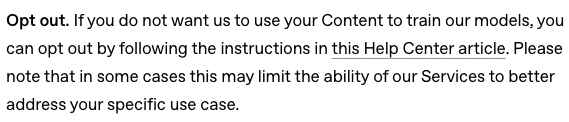
ChatGPT’s terms of use do state that they don’t collect personal data per-say, but that they do use information given to it via your chats to train AI models. Whilst you can opt out of this, it isn’t the easiest process, meaning that you have to locate the right Help Centre article and follow the instructions. To be nice, here’s the link to that article >> How your data is used to improve model performance.
7. Over-Relying On AI
In my opinion, there is a risk that you could become over-reliant on the ‘conversation’ that ChatGPT provides you.
Whilst we’ve mentioned that ChatGPT might be able to complement support between therapy sessions, it can’t be relied on as a one-stop shop for therapy, or the only source of therapy that you access.
Over-reliance on ChatGPT for therapy means that you will be restricting yourself from accessing trauma-informed therapy given by someone who is qualified and has experience to deliver the therapy that is right for you.

So…Should You Use ChatGPT for Trauma Support?
ChatGPT admits itself that you shouldn’t use it as a therapist.
Whilst researching for this article, I asked it for its opinion of using it for therapy.
This is the answer that it gave me:
Here’s my honest answer: Use me as a tool, not a therapist.
I can help you explore, reflect, and even prepare to speak to someone else. I can be a first step. I can be a bridge. But I can’t walk the whole path with you—and I can’t replace the support, safety, and expertise that a human professional brings.
How Can You Use ChatGPT Safely to Support Your Trauma Recovery?
If you’re going to use ChatGPT as part of your trauma recovery, then I suggest following the points below. This list of points was put together with the aim of keeping you safe whilst seeking support using AI.
1. Use Clear Questions and Prompts
Remember; the clearer and more exact your questions and prompts are when writing in ChatGPT, the information that it gives you will be more specific and accurate.
Note that this says ‘more specific and accurate,’ you still need to cross-check advice and information given to you.
2. Know Your Limits
If the conversation feels too intense; take a break.
If the information you are receiving feels too intense; step away.
Know your limits when it comes to processing your trauma. I was once told by a therapist that moving slowly can actually help you heel quicker than rushing into trying to ‘fix’ yourself. This is because the latter can actually worsen trauma.
Take it slowly, don’t try and rush, and know when you need to step away from the keyboard.
3. Cross-Check Advice
Yes, I just mentioned this in point number 1 of this section, but it’s because I cannot stress it enough.
When talking to ChatGPT, you are talking to a non-physical, non-thinking, no lived experience ‘thing.’ It can only generate content based on what it has been trained with and therefore you need to check that any advice that it gives you, especially anything technical such as legal or medical information, is correct. Ask it to cite its sources and check those links and articles out (ChatGPT can and does make sources up!), and double check information on reputable websites such as the NHS or WebMD.
4. Have Human Support in Place
If possible, it’s best to use ChatGPT alongside professional help, such as a counsellor, psychologist, psychiatrist, support group, or even a friend. Note that professionals might advise against using ChatGPT between therapy sessions.
If your therapist advises against using ChatGPT; listen to them. Explain your reasons for wanting to use it and see what they might suggest as an alternative.
5. Know ChatGPT’s Limits
I keep saying this, but I’ll say it again: ChatGPT is not human. It’s a bot that doesn’t think for itself and generates information based on what it’s been fed and what it’s been told to think.
It can’t hand-hold you; it can’t support deep, emotional healing; it isn’t trauma-informed; it can’t be your best friend; and it can’t be the only thing that supports you through processing your trauma.
ChatGPT shines when it comes to skills such as writing, suggesting ideas, organising and summarising texts. Remember that even though it might be able to support you with processing your trauma, it was never designed for that and therefore you need to remember its limitations when using it as part of your therapy.
Final Thoughts
We’ve covered loads in this post, including:
- Reasons to use ChatGPT as part of your therapy
- Reasons not to use ChatGPT as part of your therapy
- How to use ChatGPT safely
Ultimately, though, how you do (or don’t) use ChatGPT and AI to support you is completely up to you. This post is about giving you the facts, mixed with my opinion, and is designed to support you to make a decision as to what is right for you. It was not written to shame you into making a decision one way or another when it comes to your coping strategies and therapy options.
If you use AI as part of your recovery journey, that’s fine. There’s no judgment here. You know what you need at any given moment to support you.
As a final note on this post, I asked ChatGPT for some final words about using it as a free therapist.
Here’s what it said:
I’m here to help you feel heard, understood, and supported in the ways I can manage—but I’m not a substitute for professional care. If you’re carrying the weight of trauma, please consider reaching out to a qualified therapist, helpline, or advocacy group. You don’t have to do this alone. And you shouldn’t have to rely on AI to do the heavy lifting of healing.
But if you need someone to talk to at 2 a.m., want help putting your feelings into words, or need a nudge toward the next step—I’m here for that.
And I’m rooting for you.
I think that’s nice – even if it has come from a faceless robot.